


Home ownership, just like many other industries, is a world that often waits until something breaks before fixing it. Some companies are flipping the script in the most demanding situations—managing septic systems through real-time monitoring, predictive alerts, and intelligent infrastructure.
With a mission rooted in proactive care and homeowner empowerment, Septilink is pioneering a shift in the mindset of wastewater management; a shift from reaction to prevention. Helping to fuel this change is an integral partnership with WAGO, a global leader in electrical interconnection and automation solutions.
From Catastrophe to Control
Septilink didn’t set out to revolutionize the septic industry. However, after enduring multiple system failures in his North Texas home (including a blaring alarm at 5 am, the morning of the 2021 Super Bowl), Clint Mundt, Managing Partner and CEO, saw firsthand how outdated the status quo had become. Armed with decades of experience in IoT and telematics, including leading Kubota's North American telematics program, Mundt turned frustration into inspiration.
No matter how willing a home or business owner might be to invest in a solution, there has been no practical way to ensure a reliable, sustainable septic system. The best advice is often to simply replace it… For tens of thousands of dollars.
Perhaps the need is not simply a new system, but instead, real-time, data-driven insights that could guide smart maintenance decisions.
That revelation led to Septilink’s founding and a core offering: connected hardware and cloud-based tools that allow septic professionals to monitor system health remotely. Septilink’s technology alerts homeowners and service providers the moment a performance issue is detected, well before catastrophe strikes.
Simplicity Meets Sophistication
Septilink understood that to make a technology useful for small applications, it must be accessible. To this end, the company set out to design a monitoring system that brings a plug-and-play philosophy to a traditionally complex industry, relying on fast, tool-minimal installation.
“Our goal was a system priced like a smart thermostat but packed with industrial-grade capability,” said Mundt. “It had to be cost-effective, easy to install, and simple to retrofit—nothing goes into the tank.”
A well-intentioned vision must be grounded in reality, and for this application, that means selecting components that can deliver exceptional performance at an accessible price. That’s where WAGO came in.
Enter WAGO: Reliability in Every Connection
One of the first decisions for Septilink’s engineering team was to select appropriate terminal blocks, a choice that was founded on positive experiences at Kubota and in the RV space.
Color-coded terminal blocks are a central feature in Septilink’s systems. They simplify installation, reduce technician training time, and enhance safety in the field. And as Septilink prepares to scale, WAGO continues to be a cornerstone of its manufacturing process.
Simplifying Installation
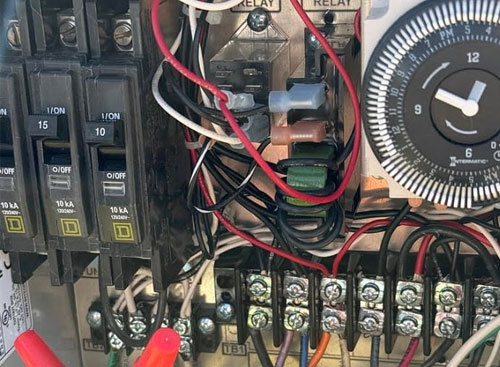
Terminal strips used in traditional septic control cabinets mostly use screws, exposed for the installing technician. The labels must be carefully followed, interpreting insulation color against listed standards. In contrast, the color-coded terminal block reduces wiring errors by allowing for industry-standard color matching.
Reducing Field Time
The right choice in terminal blocks often falls to user preference, but any selection that reduces time while ensuring fit and function is a benefit. The toolless installation levers in these terminal blocks speed up the installation time.
Enhancing Safety
A final benefit offered by terminal block solutions is the fully insulated jacket surrounding the conductive metal. For technicians in the wastewater and septic industry, the ability to work inside a cabinet with the confidence of safety is extremely important.
Finding the Right Fit
It’s not just the hardware that seals a deal on manufacturer choice. For Septilink choosing WAGO, it wasn’t just the terminal block offerings—it was the people.
According to Daniel Jimmie, who leads growth and strategy at Septilink, “WAGO made early investments in us that most companies wouldn’t, and they’ve stuck with us ever since.”
When initially assessing the product suitability, local WAGO reps hand-delivered and supported the design team. This provided confidence that everything would be provided to ensure success.
The Road Ahead: From Septic Systems to Sustainability
What’s next for the septic industry? More growth, more products, and more markets.
There are thousands of unmonitored water systems in existence, from gravity-fed septic fields to solar pumps on cattle ranches. This advanced, data-driven technology can bring intelligence to all of these situations, and many more.
Septilink is meeting these challenges with the SL-5, and is preparing to launch the upcoming SL-7 unit. This all-in-one controller, built around WAGO’s terminal blocks, finds success in applications ranging from rural homes to remote livestock pastures. Currently, the SL series products support 240 VAC pumps, dual pump monitoring, and off-grid solar applications. Future iterations of hardware will include native dual pump control and monitoring and support for industrial applications such as 3-phase monitoring.
Though these products currently thrive mainly in residential and light industrial markets, expansion into municipal and regional applications is on the horizon. The company’s modular, app-configurable approach makes it ideal for small cities and counties without massive infrastructure budgets.
A Partnership That Powers Progress
As the septic industry continues to evolve, product providers and manufacturers remain as trusted collaborators, quietly powering the connections that make this innovation possible. With shared values around engineering excellence, customer support, and smart infrastructure, this partnership between Septilink and WAGO may be a model of how startups and legacy companies can build the future together.