







Machine-tending robotic cells look simple from a distance. A robot picks a part, drops a part, and hands it off to the next operation. The conveyor keeps things moving, the sensors confirm positions, and everything operates with a kind of mechanical rhythm. The reality is that these mechanical motions are the easy part. The wiring underneath, such as the signals, the power, and the safety behavior, is where a cell is dependable or destined to become a long-term source of headaches.
The good news is that machine-tending cells are far more repeatable than they appear. Once you've built or debugged enough of them, patterns start emerging. The electrical backbone is shockingly similar across systems, and most failures stem from the same handful of avoidable missteps.
What follows is a practical wiring framework built from those patterns. It aims to give integrators a road map instead of a parts list, helping to understand why some machine-tending cabinets run smoothly for years while others become a carousel of nuisance faults and unexplained stops.
Background: How the Cell Thinks and Communicates
You might have the slickest mechanical design and the most powerful robot on the market, but if the devices can’t communicate predictably, none of it matters.
A pattern shows up in nearly every well-designed system: the robot and PLC exchange a handful of essential handshakes, the PLC coordinates sensors and drives, and the safety system stands slightly apart, feeding directly into the robot’s safety inputs.
The robot speaks to the PLC, the PLC speaks to the drives and sensors, and the safety relay or safety PLC speaks to the robot in its own dedicated loop. That repeatable structure exists because the PLC is the only component truly built to orchestrate timing across multiple devices; the robot excels at motion, not traffic control, and the drive’s world is limited to motor behavior. The PLC connects these perspectives into a coherent whole.
Noise and Power
Signal issues rarely announce themselves clearly. They appear as odd symptoms that seem unrelated to wiring. Once you’ve seen these patterns enough times, you start recognizing the electrical fingerprints of each symptom.
One of the biggest mistakes people make in their first few panels is routing convenience over discipline. Running sensor cables and motor output cables in the same duct looks tidy until the VFD ramps up, at which point the sensors start behaving unpredictably. A robot may freeze mid-cycle, waiting on a sensor whose signal is flickering because the cable is routed too close to a motor output.
Trying to put all I/O and DC motor drives on a single power supply is similarly tempting until the conveyor starts, pulls down the voltage for a moment, and the robot's network adapter drops offline.
Network or Hardwired I/O?
Good signal architecture requires thinking about how signals behave electrically, not just logically. Hardwired I/O still has its place for anything timing-critical, while fieldbus networks reduce clutter but must be routed appropriately to avoid interference. As a rule, if a signal has to happen within a few milliseconds, hardwire it; if it can tolerate minor delays, network it and take advantage of diagnostics.
When signal routing is thoughtful, the entire cell feels predictable. When it's not, the cabinet becomes a scavenger hunt every time something goes wrong.
Where Stability Is Won or Lost
If signal architecture is the brain of a cell, power distribution is its pulse. Successful panels almost always follow a familiar physical layout:
- High-power components (breakers, contactors, and drives) on one side
- Low-voltage controls (PLC, I/O banks, and communication modules) on the other side
- Safety devices occupy a clearly defined area near the center.
This spacing matters more than most people realize. Any electromagnetic noise coming off a VFD output line will couple into whatever wiring is nearby. If that wiring belongs to a sensor, an encoder, or an Ethernet module, you’ll spend days chasing problems that never seem to repeat exactly the same way.
Drive wiring deserves special attention. When power and I/O cables absolutely must cross, they should cross at ninety degrees to reduce shared exposure. A few more realities sometimes catch new integrators off guard. For example, if a VFD cable runs more than fifty feet, assume it will radiate noise unless you treat it accordingly. If multiple 24-volt loads share a single supply and startup currents are not considered, expect brownouts when the cell transitions from idle to motion.
The symptoms of poor power design are distinctive once you’ve lived with them for a while. Here are a few classic indicators that the power layout needs revision:
- Robots dropping communication, but exactly when conveyors start
- Drives tripping with undervoltage errors even though the incoming power is “within spec”
- Sensors misreading, but only during acceleration
When power distribution is done correctly, you almost forget it exists. When it isn’t, nothing in the cell feels stable.
Setting Boundaries the System Can Trust
Machine-tending cells are inherently interactive: operators open doors to load parts, approach pallets, and clear jams. Because of that, the safety system cannot be an afterthought; it has to be a predictable, intentional structure.
Most well-designed cells follow a consistent pattern.
- Light curtains or area scanners feed into a safety relay or safety PLC
- Door switches feed into separate monitored channels
- The robot receives safety signals through its safety inputs
This structure ensures the robot reacts appropriately every time, regardless of the PLC's logic.
Safety Devices
Beginners often misunderstand safety devices. A door switch may look like just another sensor, but it behaves differently. It needs to be isolated from standard I/O so nuisance resets do not cascade into safety faults. When a door switch is wired casually, mixed with regular inputs, or paired incorrectly between normally closed and normally open channels, the system may run during testing but fail during production runs.
Intermittent Safety Trips
Another subtle problem arises when safety and non-safety wiring share duct space. It creates opportunities for interference that the safety system interprets as instability. The result is a cell that unexpectedly stops, forcing operators to reset the entire safety loop, even though nothing is actually wrong.
It only takes a few of these incidents before maintenance begins “temporarily bypassing things,” which is how small wiring mistakes turn into major safety concerns. The best compliment a safety system can receive is that no one thinks about it after startup.
Commissioning Checks That Prevent Days of Troubleshooting
Before bringing a machine-tending cell fully online, a handful of checks makes an enormous difference in long-term reliability.
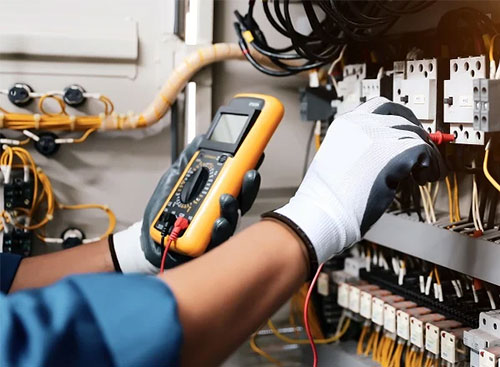
Measuring the 24-volt supply under load is mandatory; many supplies hold voltage when idling, but collapse when conveyors or brake coils activate.
Verifying shield bonds is equally important since a misplaced shield can turn into an antenna rather than providing protection.
Safety behavior should be tested in all reasonable conditions: open the door, confirm the robot stops; close it, confirm the system resets; and observe whether any steps in the sequence behave inconsistently.
Another valuable test is to rapidly accelerate the conveyor while monitoring the robot’s communication status. If the network drops, you know the power or signal routing needs attention.
Grounding should also be verified across the entire cell, as inconsistent grounding can cause tracking currents that degrade signal clarity. And every sensor should be tested with the conveyor running, not just during static checks. Many problems appear only under vibration or dynamic load.
A Practical Framework to Remember
Machine-tending cells can be understood through three interconnected ideas. Signals form the system's conversation, the way devices negotiate timing and intent. Power provides stability, and without stable power, the most elegant logic becomes unreliable. Safety creates the boundaries within which the system can operate with reduced risk.
The best machine-tending panels do not rely on clever tricks. They rely on repeatable patterns such as clean communication paths, deliberate separation of power and signal wiring, intentional grounding and shielding, predictable safety circuits, and patient commissioning. Those who learn these lessons early tend to avoid the long, frustrating nights in front of cabinets that have humbled the rest of us.